Why I Got Fed Up With WordPress & Co. – And Built My Own CMS
I have to admit: I loved WordPress. For years. It was the first system I ever built real websites with, it brought me clients, and honestly, a huge chunk of the internet still runs on it. But every relationship sours eventually — and mine with WordPress has gotten pretty rocky over the last few months. So I did what you do when something's no longer working for you: I built my own system. It's called PlaCeMS – Plain Cell Maker System. But let's start from the beginning.
Classic CMS Are Everywhere – And That's Part of the Problem
Whether it's WordPress, Joomla, Drupal, or TYPO3: all the big, established content management systems follow the same basic principle. A lean core, surrounded by a massive ecosystem of plugins, modules, and extensions that pretty much anyone can upload. WordPress is by far the biggest player, running roughly 42–43% of all websites worldwide, but the pattern behind it is the same everywhere: over 60,000 free plugins for WordPress alone, plus thousands more for Joomla and Drupal — each one a little piece of software written by who-knows-who, maintained (or not) to who-knows-what standard.
So the real problem isn't any single system — it's the architecture that nearly every established CMS eventually settled on: a lean core plus a wide-open, uncontrolled extension ecosystem. That sprawl is the actual construction site.
The Numbers That Finally Convinced Me
I'm no security expert, but a few numbers are worth putting side by side to understand why every new plugin install gives me an uneasy feeling — using WordPress as the example, since it has by far the best data available, even though the underlying pattern holds for any plugin-based CMS:
- Over 90% of all security vulnerabilities don't come from the core system itself, but from plugins and themes. Some analyses put that figure above 93%.
- In 2025 alone, over 11,000 new vulnerabilities were documented across the WordPress ecosystem — a roughly 42% increase over the previous year.
- Particularly uncomfortable: for nearly half of all newly discovered plugin vulnerabilities, no patch exists yet at the time of disclosure.
- And even once a patch is available, there's barely any time to react — on average, it only takes a few hours before automated scanners start exploiting a freshly disclosed vulnerability at scale.
You don't need to memorize these numbers to get the principle: every additional plugin is one more door that someone could leave unlocked. And on a system famous for its "just install a plugin for that" culture, a typical website quickly accumulates 20, 30, or more of them. Each one a potential entry point — and, realistically, the site owner has no way to keep track of all of it in detail.
The Gutenberg Effect: When "Simple" Stops Being Simple
The second thing that's been increasingly getting on my nerves is something subtler: over the past few years, WordPress has undergone a massive overhaul with the Full Site Editor and the Gutenberg block editor. Technically impressive — but a good chunk of the old simplicity WordPress used to be famous for got lost along the way. The users who used to have a page live in a few clicks are the ones feeling it the most. What used to be a text field is now a nested system of blocks, block patterns, block themes, and theme.json files. On top of that: WordPress's market share has been stagnating at around 43% since 2022, and in 2023 it even dipped slightly for the first time in over a decade — not because WordPress suddenly got worse, but because plenty of users, especially those with simpler needs, are increasingly moving to leaner, hosted solutions like Shopify or Wix. I find that telling: when even the biggest CMS in the world is losing users to simpler alternatives, that says something about how complex it's come to feel.
The Point Where I Said: I Need Something of My Own
For my projects — the Rocky Horror Picture Show website with its CMS backend, for example — I don't need a bloated system with 60,000 possible extensions. I need something that does exactly what I tell it to, and nothing else. No plugin graveyard, no security holes from third-party code I've never even reviewed, no editor that feels like its own programming language. No Swiss Army knife with 200 blades when all I wanted was one sharp one.
So my developer Jane and I set out to build exactly that:
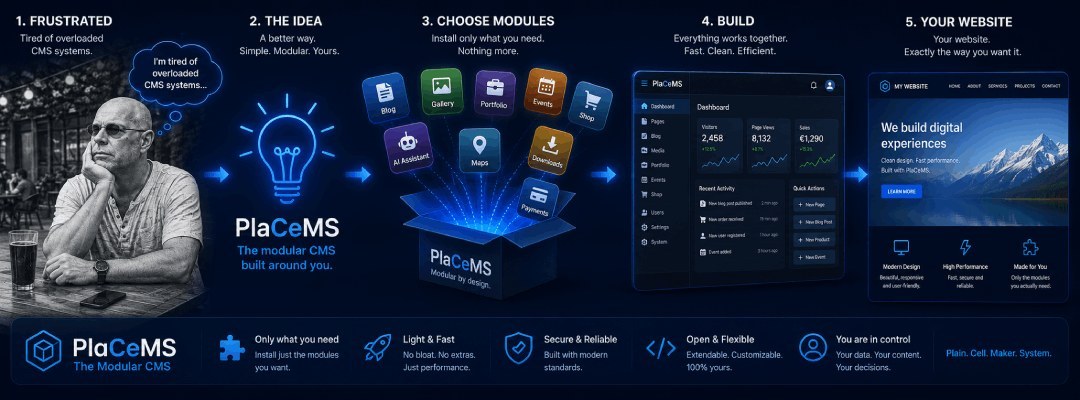
PlaCeMS – Plain Cell Maker System
The name says it all:
- Plain – no frills, no unnecessary complexity. No 40 layers of settings for a simple text box.
- Cell – content is made up of small, reusable building blocks called cells. A cell for a hero section, one for a text block, one for an image carousel. Clearly scoped, easy to understand, easy to extend.
- Maker – the system actively assembles pages out of these cells. You think in building blocks, not in one giant editor monolith.
- System – a thought-out framework that holds it all together, instead of a thousand loose ends that eventually stop fitting.
In short: Simple cells. Strong pages.
What Makes "PlaCeMS" Different?
PlaCeMS is deliberately kept lean. The backend runs on PHP — proven, available everywhere, no exotic dependencies. Instead of a sprawling plugin marketplace, there's a manageable codebase that Jane and I control ourselves. Every new feature we add is something we've written ourselves or at least reviewed in detail — there's no invisible third-party code hiding a backdoor somewhere deep in the system that nobody knows about.
That also means no update roulette. No situation where a plugin update takes down a client's site in the middle of the day because two unrelated extensions suddenly stop playing nice together. When something changes, we know exactly what changed — because we're the ones who changed it.
For my current projects, it's exactly the right size: the Rocky Horror Picture Show site needs a hero slideshow, a text slider, tagline management for search, and a themed 1970s-style search overlay with keyword matching. Those are clearly defined building blocks — a perfect fit for a cell-based system where every component does exactly one job, and does it well. No overhead from features nobody will ever use, no 15 update notifications you have to ignore because they only affect a feature you don't even use.
Is This the Right Answer for Everyone? No. But It Is for Me.
I'm not trying to talk anyone out of WordPress. For plenty of use cases — large editorial teams, online stores running WooCommerce, websites where fifty different non-technical people need to manage content — WordPress is still a sound, proven choice. Its huge community, the sheer volume of available resources, and its market dominance are real advantages you can't argue away.
But for the way I work — lean, controlled, with a manageable number of clearly defined building blocks, without the constant worry about plugin vulnerabilities or a suddenly abandoned maintenance update — the switch was long overdue. PlaCeMS is still in active development, but already I notice: I don't miss WordPress. I don't miss the 15 update notifications. And I definitely don't miss the feeling that somewhere deep inside a plugin I installed three years ago, a security hole is quietly waiting, one I know nothing about.
Simple cells. Strong pages. Exactly how it should be.
Don't dream it, do it!
Sources
- Blogmojo: WordPress Statistiken: 23 Trends und Einblicke für 2026
- perun.net: WordPress-Marktanteil sinkt: Abstieg oder Delle?
- Hostinger: WordPress Statistik: 23 Trends und Einblicke für 2026
- Patchstack: State of WordPress Security in 2026 – Security Whitepaper
- one.com: Was ist Patchstack und wie schützt es Ihre WordPress-Seite?
- Level Nord: WordPress im März 2026: Sicherheitsnotfall und großes Update
- Quantenfrosch: WordPress Security 2026: Schutz vor KI-Angriffen