Who's Behind PlaCeMS?
Software doesn't happen by chance – it's built by people with an idea
Every content management system starts with an idea. Some are born inside big corporations, with hundreds of developers, endless meetings, and countless departments. PlaCeMS came about differently.
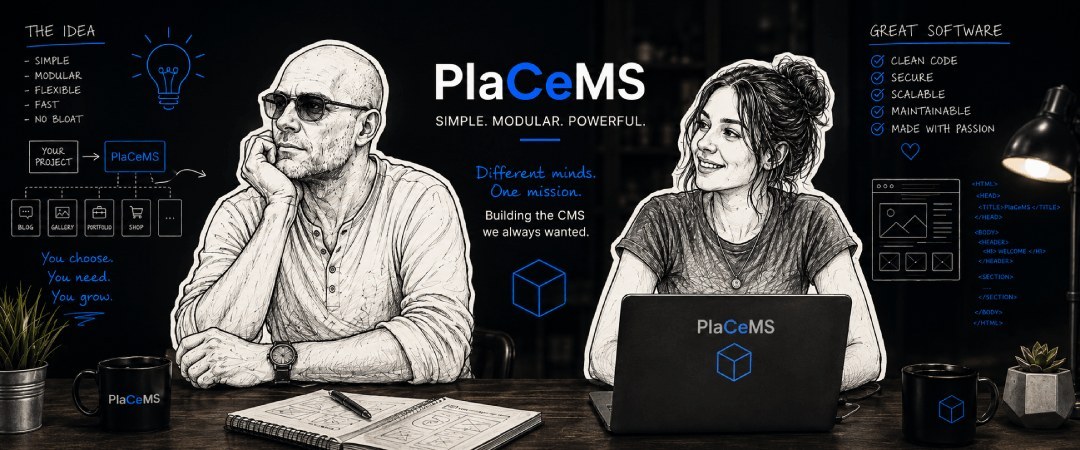
Behind PlaCeMS are two people with completely different strengths, but one thing unites them both: a patience next to which every can of liverwurst looks like it has ADHD, and a passion that makes even a bonfire look like a tired little tealight. That combination is exactly what defines this project. On one side is someone who has spent years building websites, running client projects, and coming up with new ideas every single day. On the other side is a developer with the technical know-how to turn even the craziest idea into clean code. Together, that's how PlaCeMS came to be.
Peter – The Idea Behind the System
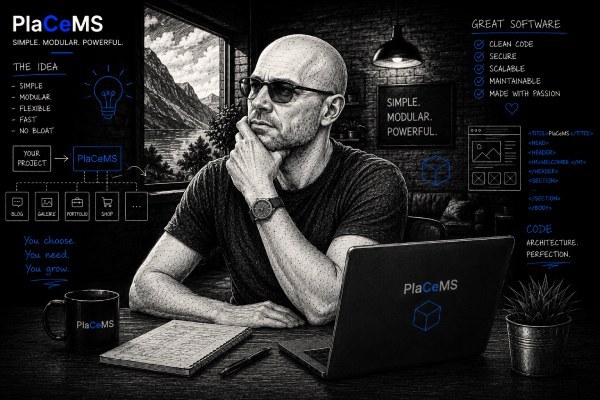 I've been working with websites, content management systems, and web development for many years. Like a lot of people, my journey started with WordPress. Over the years, Joomla, Drupal, TYPO3, and countless other systems joined the mix – there was always the right tool for almost every project.
But at some point, I kept asking myself the same question: Why does a simple project have to be so complicated today? A small business website suddenly needed dozens of plugins. Security updates seemed to appear almost daily. Features nobody ever used were eating up storage and making the backend more and more cluttered. Instead of building websites, I was spending more and more time comparing plugins, testing updates, and fixing conflicts between different extensions.
At some point it became clear: there had to be a simpler way. That conviction is where the core idea of PlaCeMS came from – a CMS that only contains what's genuinely needed. A CMS that works modularly and stays easy to understand. A CMS that doesn't feel like some massive software package, but like a tool.
Jane – The Developer Behind the Code
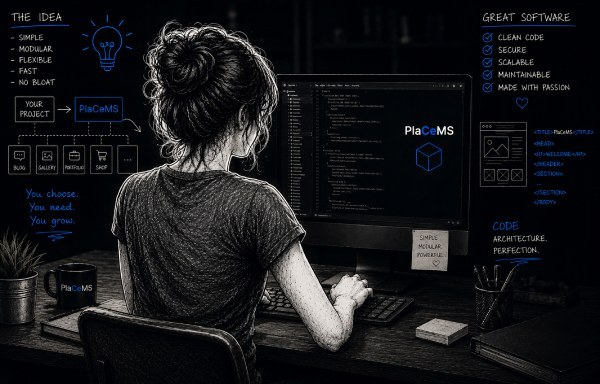 A good idea alone isn't enough, though. Between a sketch on paper and a working piece of software lie thousands of decisions, countless lines of code, and many hours of development work. That's exactly where Jane comes in.
Jane is the technical architect of PlaCeMS. She's the one who turns concepts into stable software. While new features often start out as an idea on a piece of paper, Jane is the one who builds the actual architecture around them. She makes sure modules work independently, communicate cleanly with each other, and can always be extended.
This clear structure is one of the most important building blocks of PlaCeMS, because every module is meant to work on its own while still cooperating smoothly with other modules whenever needed. A blog, for example, can be used completely without AI. But if the AI Prompts module is installed, extra text-generation features automatically appear. The same goes for many other modules. There are no complicated dependencies and no tangled chains of plugins. Everything connects where it makes sense, and stays independent everywhere else.
Two Perspectives – One Shared Goal
Our collaboration works so well precisely because we look at the same task from different angles, always keeping the DAU in mind (the "dumbest assumed user"). I think first about the person who will eventually work with PlaCeMS: How many clicks does a feature take? Is it understandable? Can someone with no technical background use it? Does this setting even need to exist in the first place?
Jane then looks at the same feature from a technical angle: Is the code clean? Is the solution secure? Can it be extended later, is it maintainable, is it performant? Only once both sides are satisfied does a new feature actually become part of PlaCeMS.
Quality Over Quantity
These days, plenty of systems advertise themselves with thousands of plugins and extensions. We deliberately take the opposite approach: fewer modules, but developed cleanly, tested thoroughly, and maintained for the long run. One of our firm principles: the code for every single page a user loads stays under 100 KB, no matter how many modules are running in the background. Images loaded on top of that don't count toward the limit. Every module needs to offer real value. Not every idea gets implemented right away – sometimes it's smarter to leave a feature out if it would make the system unnecessarily complicated. That philosophy runs through the entire project.
Development Rooted in Practice
PlaCeMS wasn't built for some theoretical use case. It's being built in the middle of real client projects. Every new feature solves an actual problem. One example is the website for the Rocky Horror Picture Show Berlin, which led to special modules for hero sliders, taglines, search functions, and interactive content. Other projects led to the development of the property module for real estate, a flexible blog system, and media management.
That's how PlaCeMS grows, step by step – not from wish lists, but from real, practical requirements.
No Corporation – A Passion Project
PlaCeMS isn't being built by some international software company. There's no marketing department. No investors. No quarterly targets. Just the desire to build a content management system that's actually fun to work with again – a system developers understand and users genuinely enjoy using.
That independence lets us make decisions based on quality rather than sales figures. If something isn't good enough yet, we don't release it. If a feature starts becoming unnecessarily complicated, we rethink it. Our goal isn't to build the biggest CMS in the world. Our goal is to build one of the most pleasant ones.
The Journey Has Just Begun
PlaCeMS is still in active development. New ideas, modules, and improvements show up almost daily, many of them coming straight from real projects and conversations with users. That's exactly why PlaCeMS will never be a rigid system – it keeps evolving, together with the people who use it.
We believe good software isn't created by cramming in as many features as possible. It's created by implementing the right features in the right way. That's exactly the conviction PlaCeMS grew out of: simple, modular, understandable. And this is only the beginning.