
Most content management systems follow the same logic: ship as much as possible right out of the box. That sounds like an advantage. In practice, it means features you never use still take up space, slow the system down and make it harder to work with.
PlaCeMS deliberately takes the opposite approach.
The Problem with “Everything Included”
Anyone who has ever maintained a large CMS knows the drill: dozens of menu items when you only need five. Extensions that get in each other’s way. Updates after which something suddenly stops working. Every feature that runs in the background is code that has to be maintained, secured and loaded, even if nobody uses it.
The Idea Behind the Name
The name PlaCeMS stands for this mindset:
- Plain: no unnecessary complexity
- Cell: content is made of small building blocks
- Maker: the system turns them into finished web pages
- System: everything fits together cleanly
The result is a CMS that adapts to your project, not the other way around.
What Isn’t Installed Doesn’t Exist
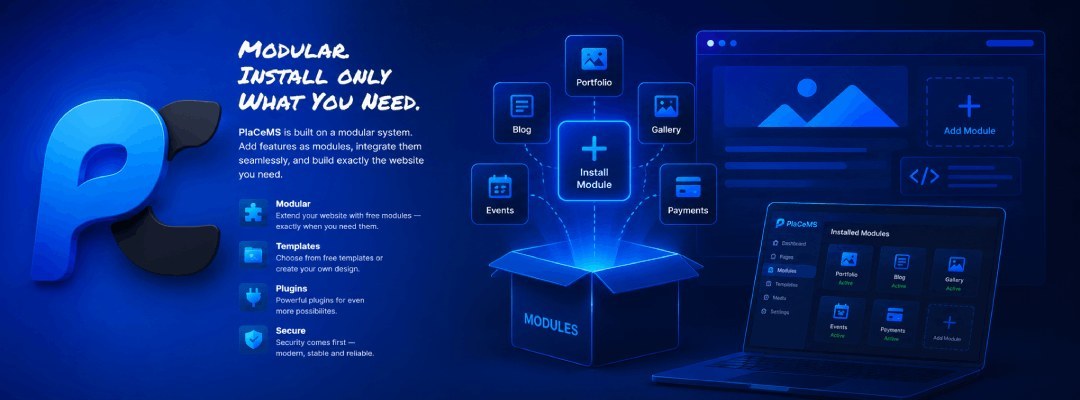
PlaCeMS has no switched-off features quietly running in the background. A module you don’t install simply isn’t there. That means:
- fewer files
- no database until you need one
- faster loading times
- lower memory usage
- a smaller attack surface
- easier maintenance
On small servers and shared hosting, that makes a noticeable difference.
Grow Without Starting Over
Websites change. A simple company site eventually needs a blog, a gallery or a newsletter. With PlaCeMS you don’t have to set up a new system for that. You add the right module, and your project grows with you.
That even applies to the database. Small projects run without one: fast, lean and low-maintenance. When your project grows to the point where a database makes sense, you add it like any other module. No migration to a new system, nothing to rebuild. Most systems force you to decide on day one. With PlaCeMS, you decide when the time comes.
Not More Features – the Right Ones
Why load an image gallery if your website doesn’t need one? Why carry a shop system around if you don’t sell anything? Why manage features nobody uses?
A good CMS isn’t measured by the length of its feature list. It’s measured by doing exactly what you need and staying out of your way otherwise.
Plain. Cell. Maker. System. A CMS that grows with your ideas, without the bloat.
👉 How the module system works in practice: [PlaCeMS Modular].