The Voice in the Background: The Mail Module
Not a visible feature—but without it, plenty of other things simply don't work.
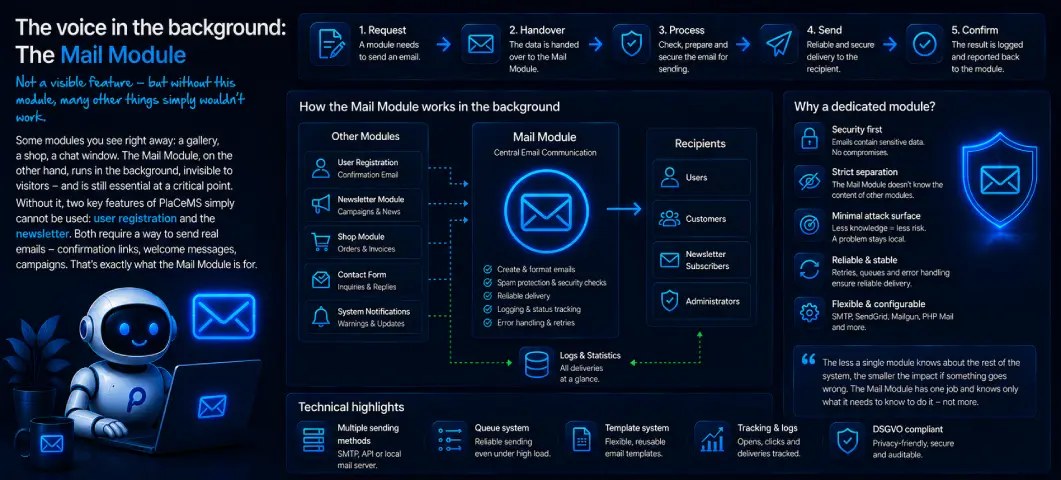
Some modules you notice right away: a gallery, a shop, a chat window. The Mail Module, on the other hand, runs quietly in the background, invisible to visitors—and yet it's essential at a decisive point. Without it, two central PlaCeMS features simply can't be used at all: user registration and the newsletter. Both absolutely require a way to send real emails—confirmation links, welcome messages, campaigns. That's exactly what the Mail Module is for.
One Job, Thought Through Consistently
Instead of rebuilding email sending separately inside every module, the Mail Module centrally handles everything related to email communication: confirmation emails for registration, password resets, notifications, newsletter delivery. Other modules don't need to worry about the actual sending—they simply signal that an email needs to go out, and the Mail Module takes care of the rest.
It's the same underlying idea as the Payment Module: one task, one module responsible for it, instead of building the same logic separately into every individual feature.
Why a Standalone Module?
Email communication is a sensitive matter. Password resets, personal confirmation links, sometimes sensitive information—all of it runs through it. These are things that leave no room for carelessness. That's exactly why the Mail Module is deliberately built as its own, independent module, instead of being woven deep into other features.
This separation has a concrete benefit: the Mail Module doesn't know the content of the other modules at all. It doesn't know what's being sold in your shop, what articles are on your blog, or who's currently registering. It only ever receives one instruction—"send this message to this address"—and it doesn't need, or get, any more context than that.
That's not an accident, it's by design: the less a single module knows about the rest of the system, the smaller the attack surface if something ever does go wrong. A module that only knows about its one job can only become a problem at that one point—not everywhere at once.
Fully Independent Operation
Because the Mail Module has no dependencies on the blog, shop, gallery, or any other module, it works entirely on its own. It can be installed, configured, and tested completely independently of whichever other modules happen to be active on your site. That independence also makes it robust: if something changes elsewhere in the system, email delivery stays unaffected—and the reverse is true as well.
Secure Communication as a Core Principle
Because email sending is such a sensitive area, it follows the same security standard as the Payment Module: credentials for your email provider (SMTP access, API keys) are stored encrypted, never as plain text somewhere in the system. The actual transmission of emails to the mail server is encrypted as well, so nothing can be intercepted along the way either.
For you, that means: set up your email provider properly once, and you can trust that registration emails, password resets, and newsletters arrive reliably and securely—without having to think about the technology behind it every single time.
Only If You Need It
Like every PlaCeMS module, the Mail Module is optional—but with one important caveat: if you want to offer user registration or a newsletter, there's no way around it. Both features absolutely require the Mail Module, because without real email delivery, neither a confirmation email nor a newsletter would ever actually arrive.
If you need neither, you can skip the module entirely—your system simply keeps running without the ability to send emails.
Invisible to your visitors, but essential for everything that needs to communicate behind the scenes—secure, independent, and focused exclusively on the one job it truly needs to master.