
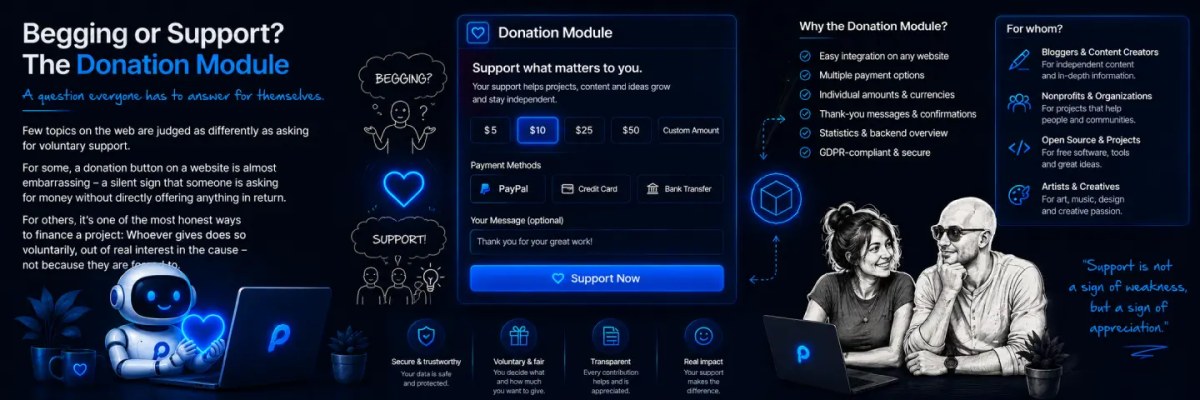
A question only you can answer for yourself.
Few topics online get judged as differently as asking for voluntary support. To some, a donate button on a website feels almost embarrassing — a quiet admission that someone's asking for money without offering anything directly in return. To others, it's exactly the opposite: one of the most honest ways to fund a project. Whoever gives, does so voluntarily, out of genuine interest in the cause — not because they were forced to.
Both views have their merits. That's exactly why this isn't about pushing an opinion on you, but about handing you a tool — in case you decide to use it.
Big Things That Grew Out of Support
Before deciding, it helps to look at what voluntary support has already made possible. A few examples many people will recognize:
- Wikipedia — one of the most-used websites in the world, completely ad-free, funded almost entirely by donations from its readers. The average single donation is about $10, given by more than 8 million donors — a small share of all readers, yet enough to keep more than 65 million articles running across over 300 languages.
- Blender — the free, open-source 3D software funded its own film projects through the Blender Foundation via crowdfunding, specifically to push its own software development forward: "Big Buck Bunny" (2008) with a budget of about €150,000, and "Sintel" (2010) with about €400,000 — both carried by community donations, DVD pre-sales, and sponsorships.
- Pebble & Oculus Rift — both products started as Kickstarter campaigns. The original Pebble smartwatch raised over $10.3 million in 2012 against a goal of just $100,000, becoming the first project ever to break the $10 million mark on Kickstarter. Oculus Rift raised $2.4 million that same year (goal: $250,000) — two years later, Facebook acquired Oculus for roughly $2 billion.
None of these projects would exist without people willing to give voluntarily — not because they had to, but because they wanted to.
There's No Right Answer for Everyone
Still, it remains a personal decision. Some projects simply don't fit with a donate button — a purely corporate website, for example, can quickly feel out of place with one. Other projects, especially personal, creative, or nonprofit ones, benefit from exactly that.
So this isn't about whether donations are "good" or "bad." It's about whether it fits your project — and only you can judge that.
What the Donation Module Handles for You
If you decide to use it, PlaCeMS makes the technical side as simple as possible. The Donation Module brings everything needed for a working donation section:
- A donate button that blends visually into your design instead of feeling like a foreign object
- Freely chosen amounts or fixed suggested amounts, exactly to your taste
- An overview of received support right in the backend
The actual payment processing itself is handled by the Payment Module — the central place in PlaCeMS for all money-related matters, whether that's the shop, member area, or donations. That means connecting your payment provider happens in exactly one place, instead of having to set it up separately in every module.
How you use the Donation Module — tucked away quietly in the footer, front and center on your homepage, or not at all — is just as much up to you as the basic decision itself.
Only If You Want It
Like every PlaCeMS module, the Donation Module is completely optional. If you don't install it, no donation prompt shows up anywhere on your website.
Begging or support — the answer is yours. The Donation Module is simply there, ready, in case you decide to accept it.
Sources
- Wikimedia Foundation: How is Wikipedia funded?
- Wikipedia: Big Buck Bunny
- Wikipedia: Sintel
- HuffPost: Here's How the Pebble Smartwatch Became the Most Funded Project in Kickstarter History
- TIME: Oculus Rift's $2 Billion Purchase